IUL vs. 401(k): Which Should You Fund First?
IUL vs. 401(k): Which Should You Fund First?
The Honest Order of Operations
Sean Matteson | Licensed Insurance Agent Since 2006
“Should I put money in an IUL or my 401(k)?” is one of the most common questions I get. It’s usually the wrong question. The better question is: in what order?
A 401(k) and an indexed universal life policy do different jobs. One is a retirement savings account with a tax break up front. The other is life insurance that can also build cash value you may be able to use later. Comparing them head to head misses the point. What matters is which dollar goes where first, and why.
Here’s how I walk people through it.
Step 1: Take the Employer Match. Always.
If your employer matches your 401(k) contributions, put in at least enough to get the full match before you fund anything else, including an IUL. A 50% or 100% match on your money is a return no insurance product can compete with on day one.
Skipping a 401(k) match to fund an IUL is almost always a mistake. Get the free money first.
How the Two Compare
| 401(k) (traditional) | IUL | |
|---|---|---|
| Main purpose | Retirement savings | Death benefit, with cash value that can be used later |
| Tax break | Up front (contributions lower taxable income) | On the back end (policy loans aren’t taxable income while the policy stays in force and isn’t a MEC) |
| 2026 contribution limit | $24,500, plus $8,000 catch-up at 50+ ($11,250 at ages 60-63) | No IRS dollar cap, but funding is limited by the policy’s MEC limit |
| Required withdrawals | Yes, RMDs start at 73 (75 if born 1960 or later) | None |
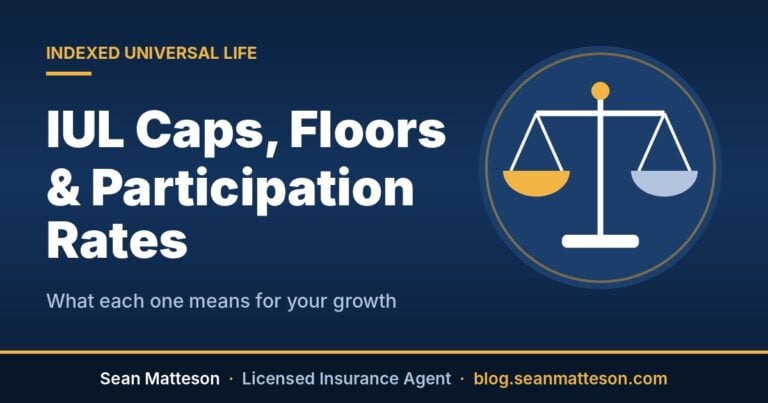
| Market losses | Yes, if invested in stock funds | No; a floor (usually 0%) means index losses aren’t credited |
| Upside | Full market returns, minus fund fees | Capped; see caps, floors and participation rates |
| Costs | Fund and plan fees | Cost of insurance and policy charges, higher in the early years |
| Health questions | None | Yes, medical underwriting |
Step 2: Know What the 401(k) Does Well, and Where It Pinches
The 401(k) is a great tool. Contributions lower your taxable income today, growth is tax-deferred, and you often get a match. For most working families it should be the foundation.
The trade-offs show up in retirement:
- Every dollar out of a traditional 401(k) is taxed as ordinary income. You got the deduction going in, so the IRS collects on the way out.
- Required minimum distributions start at 73, or 75 if you were born in 1960 or later. You have to take money out whether you need it or not.
- That income can ripple. Higher taxable income can make up to 85% of your Social Security benefits taxable and can push your Medicare Part B and Part D premiums higher through IRMAA.
- Market exposure. A big drop right before or after you retire can do lasting damage, especially while you’re taking withdrawals.
None of that makes the 401(k) bad. It just means having all of your retirement money in one tax bucket limits your options later.
Step 3: Where an IUL Can Fit
Once you’re getting the full match, some people want another place to put savings that works differently. That’s where a properly designed IUL can make sense. (If you’re new to the product, start with how an IUL works.)
- Protection first. It’s life insurance. If you die, your family receives a death benefit, generally income-tax-free.
- No required withdrawals. You decide when, and if, you use the cash value.
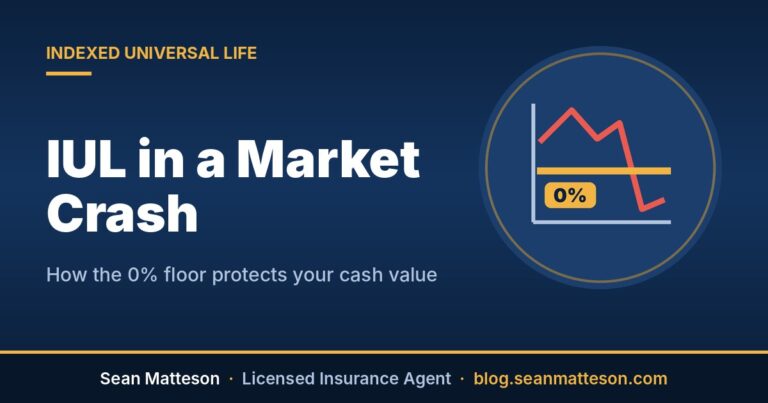
- No market losses on the cash value. With a 0% floor, a down year is credited 0%, not a loss. Policy costs still come out. More on that in what happens to an IUL when the market crashes.
- Tax-free access through policy loans, as long as the policy stays in force and isn’t a modified endowment contract (MEC).
Already maxing your 401(k) match and wondering what’s next?
Sean will follow up personally.
The Honest Trade-Offs of an IUL
An IUL is not a 401(k) replacement, and anyone who pitches it that way is overselling it. Here’s what to weigh:
- It needs time. Costs are front-loaded. An IUL generally works best with 10 or more years of steady funding before you plan to use the cash value.
- It needs consistent funding. Underfunded policies are the ones that run into trouble later in life, when the cost of insurance rises.
- Upside is capped. In a great market year, you won’t get all of it.
- You have to qualify medically. Health issues can make coverage expensive or unavailable.
I wrote about the common criticisms in more detail in Is IUL a Scam? The Honest Answer.
A Simple Order That Works for Most Families
- Contribute enough to your 401(k) to get the full employer match.
- Build an emergency fund.
- Make sure you have enough life insurance to protect your family. For many young families, that starts with term.
- If you still have money to save and a long time horizon, consider a Roth IRA and/or a properly funded IUL for tax-free income later.
- Keep adding to your 401(k) beyond the match if it still fits your plan.
The right mix depends on your age, income, tax bracket, health and goals. For a lot of people, the answer isn’t IUL or 401(k). It’s both, in the right order.
Let’s Make Sure You Get This Right
Every situation is different. Personal strategy matters.
Sean Matteson
Sean Matteson is a Licensed Insurance Agent since 2006 and a Registered Social Security Analyst. He helps pre-retirees and families understand how life insurance and retirement income products fit into a long-term plan. Based in Henderson, NV, and licensed in 31 states.
This content is for educational purposes only and is not legal, tax, or individualized financial advice. Policy features, benefits, and availability vary by carrier and state. Illustrated scenarios are hypothetical and not a guarantee of performance. Policy loans and withdrawals reduce cash value and the death benefit and may cause the policy to lapse; a lapse with a loan outstanding can create taxable income. Always consult a licensed professional and a tax advisor about your specific situation.