Social Security in 2027: What’s Changing and What It Means for Your Check
Social Security in 2027: What’s Changing and What It Means for Your Check
A 3.6% raise, new earnings limits, and a January payment that shows up on New Year’s Eve.
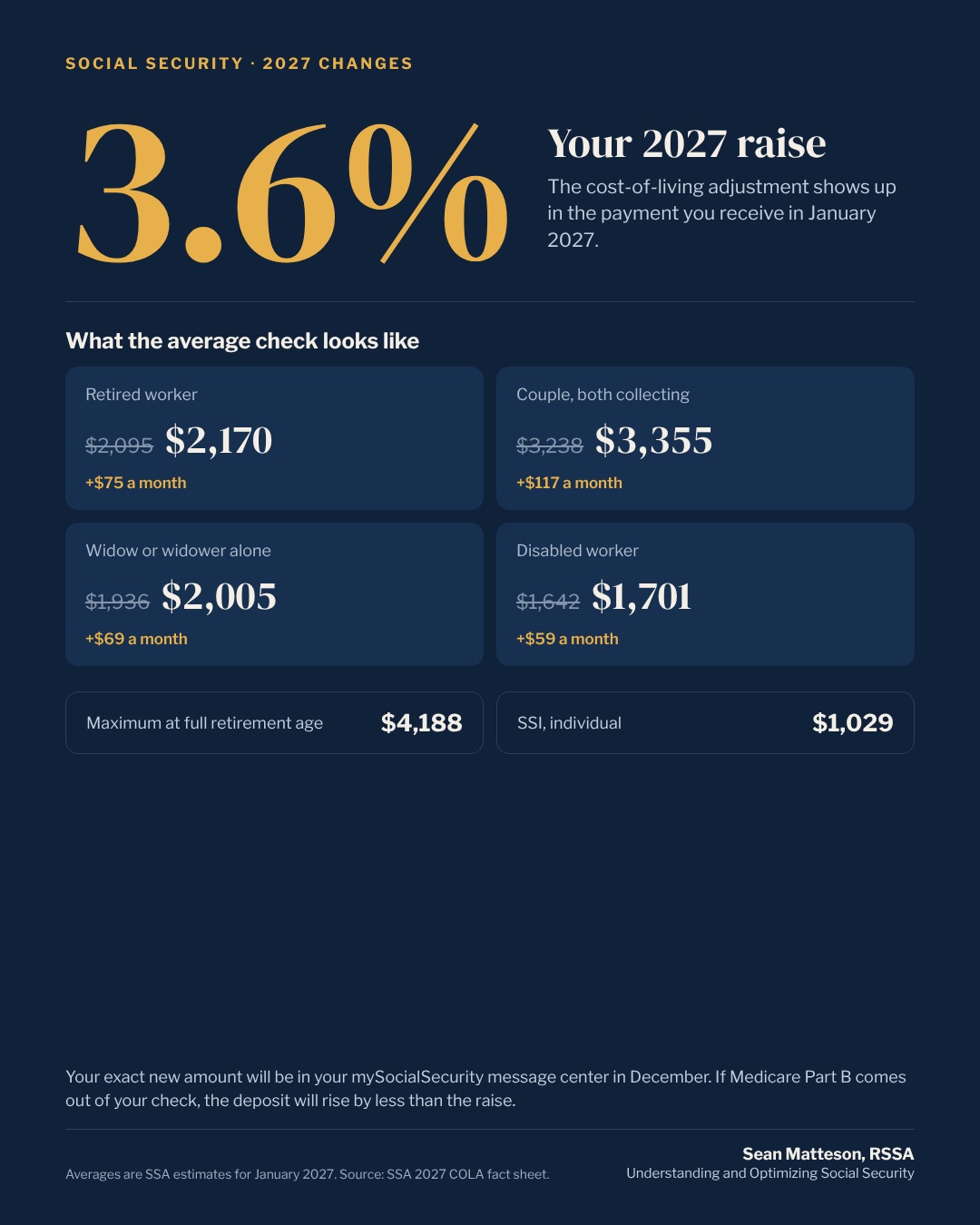
Every October, Social Security announces the numbers for the coming year. The 2027 announcement came on October 14, and the headline is a 3.6% cost-of-living adjustment. But the raise is only one of a dozen figures that changed, and a few of them matter a lot more than people realize, especially if you’re still working or haven’t claimed yet.
Here’s each change in plain language, and who it affects.
The RaiseA 3.6% Cost-of-Living Adjustment
The 3.6% increase applies to benefits for December 2026. Because Social Security pays a month behind, you’ll see it in the payment you receive in January 2027. For comparison, the increase for 2026 was 2.8%.
Here’s what Social Security estimates the average check will look like:
| Who | Before | After |
|---|---|---|
| Retired worker | $2,095 | $2,170 |
| Couple, both collecting | $3,238 | $3,355 |
| Widow or widower alone | $1,936 | $2,005 |
| Widowed parent with two children | $3,932 | $4,074 |
| Disabled worker | $1,642 | $1,701 |
| Disabled worker with spouse and children | $2,970 | $3,077 |
The most a worker retiring at full retirement age can receive in 2027 is $4,188 a month, up from $4,152.
The CatchYour Deposit May Rise Less Than the Raise
The COLA raises your benefit. What lands in your bank account is your benefit minus anything withheld from it.
If your Medicare Part B premium is deducted from your Social Security, any increase in that premium comes out of the raise first. Medicare sets the Part B premium separately from Social Security, so check the new figure when it’s announced before you count on the full increase.
The same goes for any federal tax you’ve asked Social Security to withhold. Your exact new amount will be posted in your my Social Security account message center in December.
Still Working?The 2027 Earnings Test Limits
If you’ve started benefits before your full retirement age and you still work, Social Security may hold back some of your benefit. The limits went up for 2027:
| Your situation | 2026 | 2027 |
|---|---|---|
| Under full retirement age all year ($1 held back for every $2 over) | $24,480 | $25,560 |
| The year you reach full retirement age ($1 for every $3 over, counting only earnings before that month) | $65,160 | $67,920 |
| From the month you reach full retirement age | No limit | No limit |
Two things people miss. First, the test only counts wages and net self-employment income. Pensions, investment income, annuities and VA benefits don’t count. Second, money held back isn’t lost. Once you reach full retirement age, Social Security recalculates your benefit to credit you for the months it withheld, so your check goes up from then on.
Payroll TaxThe Taxable Maximum Rises to $192,300
The 6.2% Social Security tax applies to earnings up to $192,300 in 2027, up from $184,500. If you earn more than that, more of your pay is taxed. The upside is that those same earnings count toward your future benefit. The tax rates themselves did not change.
Work Credits$1,970 Earns One Credit
You need 40 credits, about ten years of work, to qualify for retirement benefits on your own record. In 2027, you earn one credit for every $1,970 in covered earnings, up to four a year. That means $7,880 in earnings gets you all four credits for 2027.
DisabilityNew Limits for SSDI
If you receive disability benefits and work, the monthly earnings limit for substantial gainful activity rises to $1,770, or $2,950 if you’re blind. A month in which you earn more than $1,270 counts as a trial work month.
SSISupplemental Security Income
The federal SSI payment rises to $1,029 a month for an individual and $1,544 for a couple. Some states add a supplement on top of that.
Turning 62 in 2027?Your Formula Is Set This Year
If you were born in 1965, you become eligible in 2027, and your benefit is calculated with that year’s formula. Your average indexed monthly earnings are split into layers. Social Security pays 90% of the first $1,340, 32% of the amount between $1,340 and $8,077, and 15% of anything above $8,077. Those dollar amounts, called bend points, rise with wages every year, which is why each birth year gets its own formula.
Paid on the 3rd?Your January Check Arrives December 31
January 3, 2027 falls on a Sunday. If your benefit is normally paid on the 3rd, which mostly means people who started before May 1997 or who get both Social Security and SSI, your January payment will arrive on Thursday, December 31, 2026.
It isn’t an extra check. It’s January’s payment, raise included, arriving three days early. By law it counts as 2027 income for tax purposes, so your 2026 tax form won’t show 13 payments. Just remember your next deposit won’t come until February 3, so make that money last about five weeks.
If you’re paid on a Wednesday based on your birthday, your January date doesn’t change.
Next StepsThree Things to Do Now
First, log in to your my Social Security account at ssa.gov in December and find your 2027 benefit notice. That’s your real number, not an average.
Second, if you’re working and collecting before full retirement age, compare your expected 2027 earnings to the new limit. If you’ll be over, you can tell Social Security in advance rather than face an overpayment later.
Third, if you haven’t claimed yet, check the earnings history in that same account. Every year counts toward your benefit, and mistakes are much easier to fix before you file.
Questions About Your Own Numbers?
Every situation is different. Text 702-605-6038 and Sean will follow up personally.
seanmatteson.com | sean@seanmatteson.com
This content is for educational purposes only and is not legal, tax, or individualized financial advice. Benefits and eligibility vary by individual situation.
Sean Matteson is a Registered Social Security Analyst and Licensed Insurance Agent since 2006. He specializes in Medicare, Social Security planning, and retirement income strategies for pre-retirees across the country. Based in Henderson, NV.
Not connected with or endorsed by the United States government, the Social Security Administration, or the federal Medicare program.
Sources: Social Security Administration, 2027 COLA Fact Sheet. Social Security Administration, 3.6 Percent Benefit Increase for 2027 (October 14, 2026). Society of Actuaries Retirement Section, Social Security Changes for 2027 (October 2026).